The post Updated: Google penalizes mobile sites using sneaky redirects appeared first on Search...
Please visit Search Engine Land for the full article.


If you're part of a marketing team, you know that trying to wrangle all of your projects can be about as frustrating as playing dodgeball blindfolded. Your landing pages need updating, your content calendar is behind schedule (again), and you've been trying to launch that new product video since the Dark Ages. Oh, and sales needs more leads. Yesterday.
Why is it so tough to get a handle on everything? That's where Scrum comes in.
In this post, I'm going to show how Scrum can help you transform your marketing processes from a quagmire of frustration into a streamlined bastion of ingenuity that would make even MacGyver proud.
Scrum is a rugby term that refers to a closely-knit huddle of burly men who are bludgeoning each other for possession of a leather-covered ball. Scrum is also a learning-based project-management approach. It helps teams focus on priorities while remaining responsive to new circumstances. While it's commonly used in software development, you can apply it to any discipline. Especially marketing.

You can read entire books about Scrum, but there are two principles that I want to outline here:
Traditional project management says that you should plan every detail of an initiative ahead of time. Once the planning phase is complete, your team simply executes against the plan. Simple, right? Sure – except real life isn't like that. And those plans you worked so hard on can suddenly become obsolete.
Scrum eschews that approach. Instead of spec-ing out your new website in minute detail in advance, you'll break a project into smaller chunks – tweaking your plans at each stop along the way. This is why Scrum is called an agile approach. Sanity is now within reach!
Wouldn't it be great if your team got better every week? With Scrum, your team regularly and intentionally improves its processes. You'll be like HAL 9000 from Space Odyssey: 2000 – you'll use what you learn to get smarter and will soon want to take over the world (except unlike HAL, you'll use your powers for good).
Scrum even helps you measure your output to see how much you're improving, which I'll show you how to do in a bit.
There are key concepts of scrum that you should be familiar with first:
Here's a 30-second overview of how to use Scrum:
Great, so what do these principles look like in practice? Keep reading for a step-by-step breakdown of how to get started.
Just like Ironman needs Jarvis to keep track of everything, you need a repository for all those amazing ideas swimming around your head. Enter the backlog.

There's just one maxim you need to know about the backlog: an unkempt backlog is worse than no backlog. If you don't nurture your backlog, it will soon turn into an overgrown, abandoned parking lot of ideas that would look right at home in a post-apocalyptic zombie movie.
Get a handle on your backlog with these steps:
To give you a sense of how this looks for a marketing team, here are a few items from our own backlog:
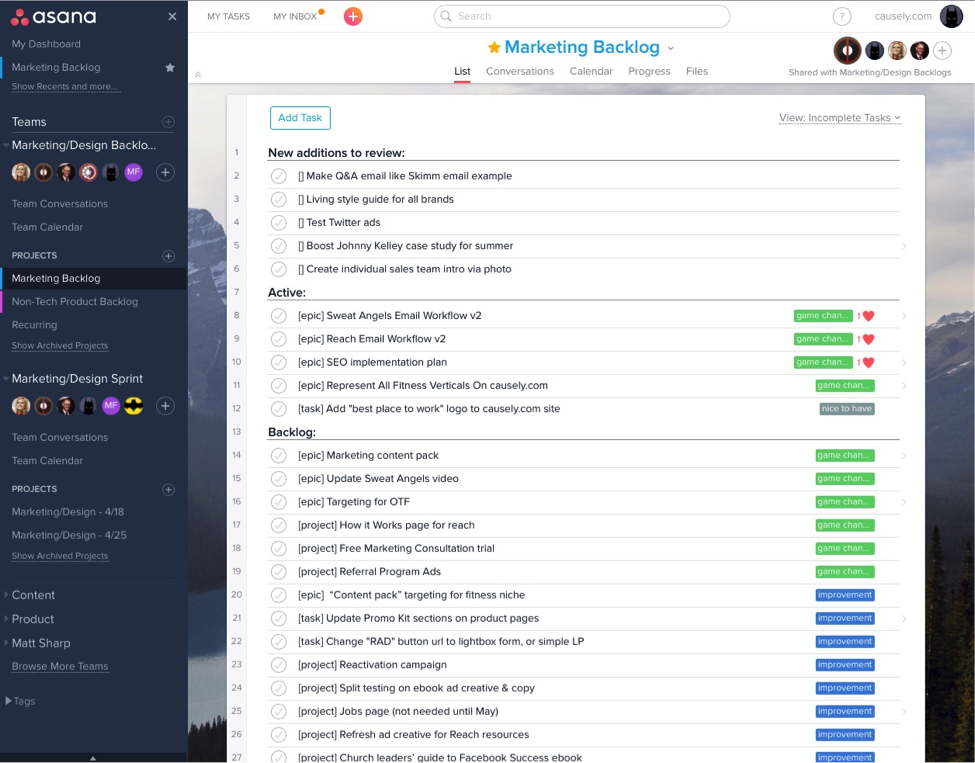
To keep everything tidy, segment your backlog into these three sections:
Now that you've got your backlog defined, roll up your sleeves, take a swig of coffee and build your first sprint plan…
Think about a sprint like planning for an epic journey across Middle Earth. It would be silly to plan every stop in advance. There are too many unknowns that could impede your progress: orcs, elves, and even giant talking trees.
Instead, you'll focus on just the first day. If you're departing from the Shire, you might target Bree as your destination. All you worry about on day one is getting to Bree. You can map out stops for second- and third-breakfast, debate over which type of beer you're going to drink at day's end, and even estimate your arrival time pretty accurately.
The following day you'll focus the next destination, and things can progress smoothly from there (at least until the Eye of Sauron notices you).
OK… each leg of your journey? That's what each of your sprints is like.

To build your sprint plan, you focus on a select group of projects – not everything in your backlog. Here's how to get started:
There are two signs that you've done things correctly: everyone has a clear idea of what they'll be working on, and you've planned just enough work to keep everyone productive during the sprint.

Our first sprint plans were like slow jogs in untied shoes. Some 50 sprints later, we're like that guy who annoys his friends by telling them about every marathon he's run.
Here are some tweaks we've made along the way:

This is your opportunity to get a status report from your team. Each person will share three things: what they did yesterday, what they plan to do today, and what they need from others to move forward. If there are any roadblocks, they're addressed here.
For example, let's say a blog post can't be published because the creative isn't ready. Instead of scrambling at the last minute, you'll have the chance to solve the problem ahead of time.
The daily standup is also a good time to bring up “impromptu” projects (unplanned work that needs to be added). Maybe you discovered an error in an email workflow that needs to be corrected ASAP. During the standup, you can raise this issue, identify someone to tackle it, and adjust the sprint plan accordingly.
Bonus: come up with a cheer your team can break on at the end of each sprint. Yes, the rest of your company will roll their eyes at you but that's half the fun.
Remember assigning those story points to your projects at the beginning of the sprint? (Those were the estimates of how much work each project would take.) This is your chance to see how many points your team actually got done. Here's how:
With your baseline established, you'll easily be able to see when your team under- or over-performs. Which brings us to the real point of the retrospective: constant improvement. Here's how to lock it in.

First, ask each person on your team to share what went well during the sprint. Perhaps someone found a way to reduce the time needed to build a landing page by 20%. By sharing this knowledge with the team and making it part of everyday practice, you can lock in that improvement going forward.
Next, ask everyone to share what problems they encountered. This isn't a chance to blame others – it's an opportunity to find better ways of getting things done. Keep talking about the challenges you faced until you identify potential solutions.
Finally, add the implementation of those solutions to your next sprint. For example, maybe your marketing campaigns take forever to get completed because everything is done ad hoc. For the next sprint, add a project to create a clear campaign process for your team.
If you can come up with just one improvement per week, your team could make 50 process improvements in a year. And guess what? Those improvements will add up big time. Not only will you get more story points done, you'll progress from being Rocky the noob boxer to Rocky the Apollo Creed-decimating prize fighter.
While there's no “best” app for Scrum, we've found that Asana works really well for both managing the backlog and planning sprints. It allows us to keep everything in one place and it's great for handling sub-tasks.
Other tools to consider are Trello, Basecamp, and even Google Docs. Heck, some teams even use a whiteboard and sticky notes.
Bonus reason for using Asana: rainbow-generating unicorns that fly across the screen when you complete a project. Does your current project management software provide unicorns? I didn't think so.
Slack isn't just another glorified messaging program – it's so good that you may be tempted to name your first child after it. We use Slack's channels feature to help us sort through messages. For each project in a sprint, we create a new Slack channel. Any messages related to that project go there. When the project is complete, we archive the channel and never have to see it again.

Scrum isn't a panacea. In fact, it will probably be pretty messy when you start. But if you put in the effort, you'll see your team grow like the Hulk (minus the rage, purple pants are optional). Not only will your team produce more, but they'll enjoy their jobs more. Better planning = less stress = happier people.
So if you decide to try Scrum with your marketing team, stick with it for at least a month before you decide if it's right for you. And make sure to get your team on board first. I suggest having everyone on your team read Scrum: The Art of Doing Twice the Work In Half The Time by Jeff Sutherland and J.J. Sutherland before you begin.
Already use Scrum with your marketing team? If so, I'd love to hear how it works for you. If you have any tips to share, please add them in the comments below!
About the Author: John Rougeux is Co-founder and CMO at Lexington, KY-based Causely. His company helps businesses and organizations generate referrals by supporting world-class charities through its Sweat Angels, Check-In Angels, and Reach programs. Chat with John on Twitter at @johnrougeux.


Whether or not business school is worth the investment is a hot topic these days. But regardless of where you stand, you don't have to go to business school to gain a better understanding of how businesses work.
"Business" is quite a versatile topic with many components. There's a lot that goes into becoming more business-savvy, whether it's learning the "softer" skills (like people management and public speaking) or mastering the "hard" skills (like accounting and finance).
Aside from studying for a formal degree, where can you go to learn about and practice these important business skills?
Turns out, there are a whole lot of resources, both online and offline, where you can hone your business skills, learn new strategies, and make sure you're staying on top of the ever-evolving business world. Here are 11 of the best resources out there to help you become more business-savvy.
Having a career mentor (or a few career mentors) with business experience is a crucial part of your professional development. Opportunities are attached to people. Your mentor can provide you with support and advice when you need it -- and, if you choose wisely, they'll learn how to deliver that support in a way that makes sense to you.
One key to finding a great mentor is to have some clear goals in mind for the type of experience you want your mentor to have. Are you looking for someone who works in an industry you're interested in learning more about? Someone with experience in raising capital for a new business? Someone who's senior to you at your current company?
Once you have a goal or two in mind, there are many ways to actually find a mentor. Don't just go straight for the most visible and well-known (and probably busiest) people. Instead, take a look at your own network and keep an eye out for folks you respect with relevant experience. You can search your network on LinkedIn -- which means you'll first want to update and clean up your own LinkedIn profile. If you find someone who isn't a direct connection, send a personal message with your connection request, or ask for an introduction from a mutual connection.
But sometimes, it's as simple as asking your friends and peers who they think would be great for you to talk to. Then, you can ask for an email introduction.
My last tip here? Keep it local. While online mentorship is great, relationships grounded in quality time in-person time are usually a lot more effective. Even better, get out of the office and into an environment that's more conducive to relaxing and candid conversation, like a coffee shop or a lunch place.
(If you're on the other side of the mentor-mentee relationship, read this blog post to learn how to be an amazing mentor.)
While content is getting more and more snackable these days, there's still a whole lot of power in a great book. The research and writing and editing required to publish a book -- especially a best-seller -- is far more impressive than what goes in to an article or podcast.
But, of course, there's an overwhelming number of business books out there for choose from. And given how much time it actually takes it read a book from cover to cover, you'll want to make sure you're making the most of your time.
So ... where better to go for the best books on business than the plethora of syllabi from Harvard Business School? To help you narrow down your search, my colleague Lauren Hintz combed through these syllabi for the 11 most intriguing books on HBS students' required reading lists. I've listed a few of these books below, but read her roundup for the full list with summaries.
One way to learn from experienced business leaders and innovators who have first-hand knowledge of the business world is to find and watch recordings of their talks online.
TED, for instance, has some really compelling talks about business strategy you can watch for free. Here's one from Bill Gross, a man who's founded many startups and incubated many others, on why some fail and others succeeded based on data from hundreds of companies:
There's also a lot you can learn about business from graduation speeches, from Michael Lewis' speech at Princeton about the profound connection between success and luck, to Marissa Meyers' speech at Illinois Institute of Technology about the importance of asking the right questions, surrounding yourself with the right people, and finding the courage to do things that are uncomfortable. Here's a list of eight inspiring graduation speeches with valuable business lessons you should definitely watch.
Finally, we have recorded lectures series from graduate business schools, featuring top business and government leaders from around the world. These may not be as exciting or glamorous as TED talks or graduation speeches, but many of them get into the nitty-gritty details of business strategy -- the hard skills that the other types of talks don't tend to get into.
While most of the live lectures are closed to non-students, many of them are posted online later. Here are a few speaker series to get you started:
Let's not beat around the bush here: Public speaking is a required business skill. There's a critical value in being willing and able to communicate effectively with your team, investors, customers, and so on. A research study showed that 70% of employed Americans who give presentations agree that presentation and public speaking skills are critical to their success at work. Some say the other 30% just don't know it yet.
You can start by reading about public speaking, like in this helpful guide of public speaking tips, or this uneasy speaker's guide to confident public speaking. But this is one skill where practice is crucial -- which is why you should join some sort of public speaking club or group if you're serious about making measurable improvements.
Toastmasters is probably the best public speaking club out there. When you join, you're put on a track where you can regularly deliver speeches, get feedback, lead teams, and participate in improvisational speaking games in a super supportive atmosphere. Plus, these clubs are all over the world -- more than 15,400 different Toastmasters clubs in 135 countries worldwide, to be more precise -- and you can use their "Find a Club" tool to find the one closest to you.
If you're willing to step out of your comfort zone, there's actually a lot you can learn from improv about business. It can teach you how to react and adapt to new situations, how to become a better listener -- perhaps most importantly -- how to stop fearing failure.
Improv classes are offered in cities and towns all over the world. Try searching on Google for "improv classes" + the name of your city, like "improv classes Boston." (Here are some more Google search tips to help you narrow it down.)
If you need some more inspiration, check out the INBOUND15 Bold Talk below by Dave Delaney, a seasoned improv performer and author of New Business Networking. In it, he talks all about how improvisation can improve your networking, creativity, communication, teamwork, and leadership skills.
There are a lot of resources for soft skills in here. But what about the hard skills that are so critical to business knowledge, like finance, accounting, marketing, and operations? For these skills, which require absorption of new information, repetition, and practice, we recommend taking more formal approach.
There are plenty of places you can pay to take online business classes. Coursera, for example, has a four-class specialization package called "Wharton Business Foundations," which includes four online classes from the University of Pennsylvania's Wharton School of Business in accounting, finance, operations, and marketing.
But if you're looking for a high-quality resource for online courses that's free, well ... Khan Academy is the easy winner. Their whole mantra is that you can learn anything for free -- and, like Facebook, they claim their services will always be free.
Their courses are a myriad of lectures, interactive exercises. And their businesses courses include, but are not limited to, courses in microeconomics, macroeconomics, finance and capital markets, and entrepreneurship. Simply go their homepage and click "Subjects" from the top navigation bar, choose "Economics and finance," and then click the topic you want to study.
But their business-related courses aren't limited to the ones in these categories. Use the search bar to find specific course topics -- from the fluffier stuff, like "Turning a Hobby Into a Bright Business," to the more complex, like "Derivative and Marginal Cost."
Another great place to learn hard skills like investments and accounting is Investopedia, a site dedicated to educating people about finance. There's great content everywhere on their site, but I want to point your attention in particular to Investopedia's "Guides" section. This is where you can find a whole slew of guides on everything from accounting basics to valuing employee stock options to how to write a business plan.
Their dictionary -- which is how Investopedia started, by the way -- is also a great resource for when you come across finance-related terms you aren't familiar with. When you educate yourself on what an Angel Fund is, or how to invest capital back into your business, you'll all a lot more value.
Each definition page includes a sentence or two defining the term, a breakdown of what it means, a list of related terms (for example, on the page for "leading indicator," you'll find a link to "lagging indicator"), related content like blog posts, and any related videos.
Whereas Investopedia and Khan Academy cover more of the accounting, finance, and operations-related material, HubSpot Academy is a great place to go for marketing and sales skills. Taking the time to hone these skills will allow you to better understand how businesses work and oversee areas of a business, even if you don't completely master them.
HubSpot Academy offers a few online certification courses that are free and open to anyone, whether or not you use HubSpot's software. Each class includes training videos, helpful documents, quizzes, and a final exam you need to pass to get your certification.
Bonus: You can also get a Google Analytics certification for free by taking Google's GA proficiency course online, and then passing the Google Analytics IQ exam.
Business podcasts serve as a great way to stay informed and inspired when you're on-the-go, like on a run or during your commute. You can tune into everything from one-on-one interviews with today's top leaders to recaps of the day's most pressing business news.
To save you some time, here's a list of some of the best business-related podcasts out there:
(Here's a list with even more business podcast suggestions.)
Carefully crafted business content is great, but sometimes, getting business news, opinions, and quotables in the form of a quick tweet is exactly the kind of snackable information you're looking for. If you want to just see the content from your favorite Twitter users separate from everyone else, you can create a Twitter list or stream.
Now that you've made your lists ... whom do you add to them? There's a lot of crap out there on Twitter. It's best to narrow down people tweeting out the best of the best content about business.
For that, I turn to Kavi Gupta, an investment banker for Merrill Lynch who's spent some considerable time narrowing down the top Twitter profiles for business content. Here are four of his favorite people to follow on Twitter for good business content:
Managing Partner in Asia for We Are Social, Kemp tweets out research he finds on social media, mobile penetration, and internet-related behaviors all over the world -- especially in South East Asia. In his tweets, he likes to single out the most important slide from a given slide deck rather than making followers sift through an entire presentation.
Does social media really work for #B2B marketing? https://t.co/aEkLxJKtfc pic.twitter.com/KZrH8K9z1x
- Simon Kemp (@eskimon)
April 28, 2016
Subrahmanyam (or Subbu for short) is Gupta's Wall Street Journal, Economic Times, and Reuters guy. He has a knack for finding the best business information from these media sources, while also adding his own, summarized insights from whatever article he's tweeting. He also tends to screenshot the most quotable parts of a post to draw readers in to the full article.
Moving fast. Volvo to test self-driving cars in London by 2017. https://t.co/EPsnBLO4LI pic.twitter.com/pUG5ahn799
- Subrahmanyam KVJ (@SuB8u)
April 27, 2016
Than's content on Twitter is refreshingly novel. Instead of sharing what everyone else is sharing when news breaks, she tweets out stuff like cool data visualizations, charts, and link that showcase a fresh perspective. She's also a master at summarizing content in her tweets in a way that's helpful and interesting to her followers.
More recent college grads are finding work, but in jobs that don't require college degrees. https://t.co/MnPP0ypPqb pic.twitter.com/VuhVSNoU7w
- Ninja Economics (@NinjaEconomics)
April 27, 2016
A VC at Binary Capital and a former employee at Product Hunt, Zhong tweets out a collection of "stumbled-upon quotes, advice, and musings on the current business landscape," writes Gupta. What he likes most about her Twitter style is that you don't have to click out and away from your feed to get her content -- because, most of the time, she's tweeting visuals, statements, and thoughts without many links.
2016: the year VCs switched from Medium/Twitter to Snapchat as a platform for their thought leadership
- Tiffany Zhong (@tzhongg)
March 17, 2016
You know as well as I do how much content there is about business on the internet these days. Some of it is really good, and some of it is crap -- and both sides of the quality coin can be found on the same website.
But if you're looking for a resource that constantly puts out high-quality content about business, Harvard Business Review (HBR) is your source. Their articles, both online and in print, are always written by experts, and their most popular topics include managing people, leadership, strategy, communication, innovation, technology, entrepreneurship, and other business topics.
If you like reading and you have some extra money to spend, some of the material in HBR's online store might be worth the investment. For example, editors at HBR created a box set of "must-reads" from combing through hundreds of articles and selected what they believe are the most important ones to help you maximize both you and your organization's performance.
Which resources can you add to the list? Share with us in the comments.

The sales funnel. It all seems so smooth and simple, doesn't it? Lots of prospects come in through the top, only to move in various, predictable stages like “Awareness” and “Discovery” only to come out the bottom as loyal, committed customers.
Except the reality of today's sales and customer experience process is anything like that.
Things like brand advocacy, social media, and even our own experiences have changed the way we market to others. Why then should we stay stuck in this rigid, old funnel structure?
We shouldn't – and today's article will show you why.
According to the Harvard Business Review, there are a myriad of ways that people learn of and interact with a product. There are even times when customers don't come through the top of the funnel, but rather somewhere in the middle.
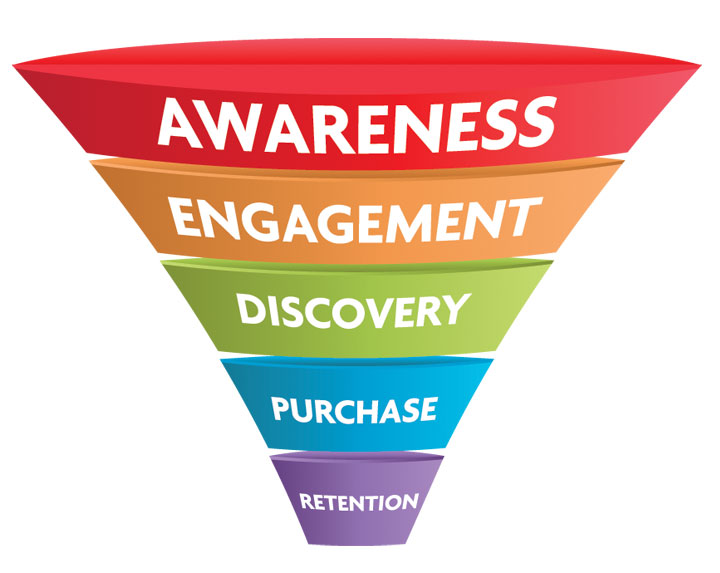 A typical marketing funnel starts with more customers in the “Awareness” stage and ends with fewer in the “Retention” phaseLet's say you were in the market for a new pair of running shoes. A friend recommends a specific brand and links to them on Facebook. On their page you can see user comments and testimonials as well as active discussions. You've just completely passed the Awareness and Discovery parts of the funnel and moved on to Engagement and likely even Purchase – because a recommendation from someone you trust is that valuable to you.
On your way to purchase these shoes, the company recommends some specialized insoles to help cushion your feet. Great idea. Now you've instantly moved from consideration to purchase. It's also possible that you could go back and forth between funnel stages while you evaluate different products or brands.
And with networks like Twitter, Facebook and Pinterest always available at the tap of a button, the traditional sales funnel we all know and refer to ends up looking more like a pretzel, with twists, turns and overlaps at every corner.
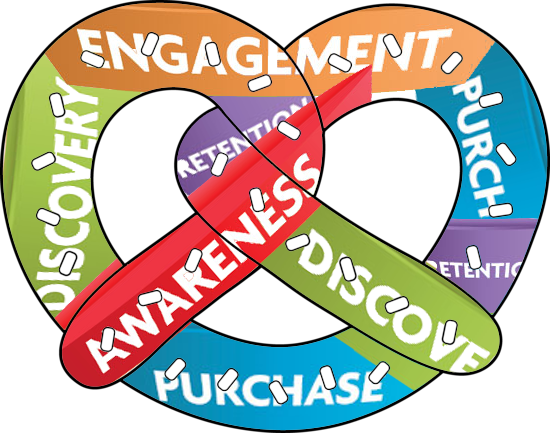 Users will often double-back on their decisions, or switch between two points instantly
According to Antonio Lucio, Chief Brand Officer at Visa, the end goal is to shift priority from the transaction to the customer relationship. To that end, Visa has created the “Customer Experience Journey” which looks at the process from transactions being a part of the customer relationship rather than the customer relationship being viewed purely in terms of transactions.
He gives the example of a family planning a trip from the U.S. to Mexico. Visa has mapped out the whole experience:
You may see this list and think “Well, Visa is part of only one of these options” – which is true when you're looking at each one as a transaction.
But step back a moment and look at the bigger picture. Every one of these points is conducive to building and nurturing the relationship with the customer. The transaction itself is just a small piece of the puzzle and not the end goal. According to Lucio, “[w]hen you change from decision to engagement, you change the entire model.”
Here again, if you're looking at the funnel purely from a revenue point of view, or spending too much time focusing on transactions, the customer experience gets lost in the shuffle. It becomes too much of a focus to think only of the numbers and not of the people driving them. If you zero in on numbers alone, you miss out on so much more. Just look at brands like Tesla Motors on Facebook. Do you think there are nearly 1.5 million Tesla owners?
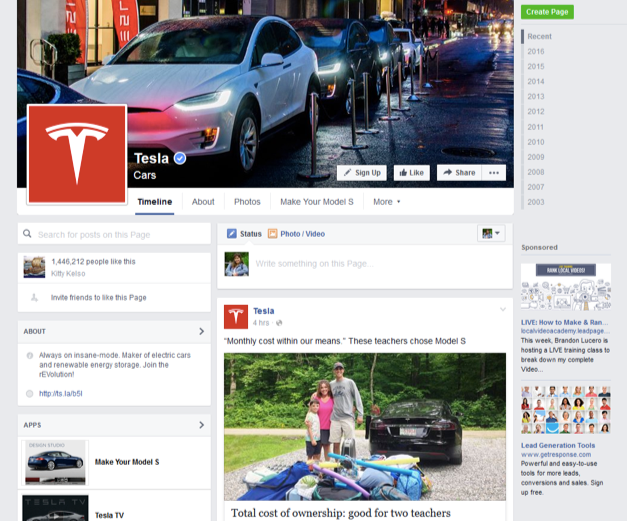 Tesla Motors has nearly 1.5 million followers – not all of them customersNot yet – but these people admire what the company has been able to build and the values they stand for. All of those things feed back into the brand itself and create the customer experience. Even digital products and services like SaaS and mobile apps can benefit from this adjusted funnel. As the Harvard article explains, with traditional funnels, marketing is a separate entity. With SaaS and other platforms, the marketing and the service go hand in hand.
The Salesforce AppExchange, for instance, doesn't just look at the process as “how do we market this?” but rather, “how do we add value to this so that the things we recommend market for us?” Many of the apps profiled here weren't made by Salesforce, but Salesforce and the apps it works with form a kind of symbiotic relationship where both parties win.
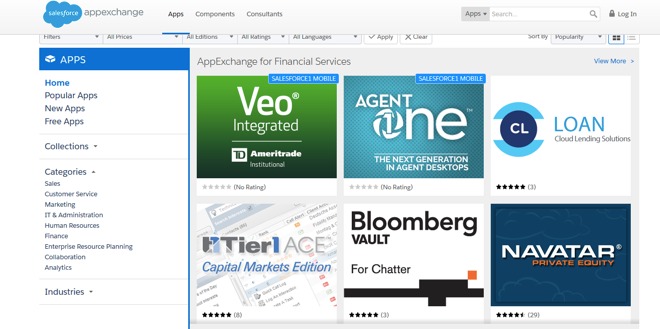 Not all apps featured on the AppExchange were built by Salesforce, but all of them use it to enable their own customer experience journeysAnother example is Google. What started out as solely a search engine has branched out to become a search engine, email service, word processor, storage service and countless other services, all entwined under a single brand umbrella. Every service plays well with other services – making it faster and easier for us to create, communicate and share. And our brains thrive on faster and easier.
Sure, there are other search engines out there, even other companies that have just as much influence as Google. But they don't integrate in a way that makes our experience faster, easier or better. When was the last time you found exactly what you needed within seconds, using Bing?
As the Harvard article says, the traditional funnel isn't going away anytime soon. There are still products and services out there that gain new customers this way. But to overlay and apply that to our more open, two-way communication world is just trying to fit a round peg in a square hole. It's not flexible, not adaptive, and just doesn't work – leading to poor experiences for everyone.
When you look at marketing as the multi-faceted beast it is, you'll be able to create your own funnel “roadmap” that incorporates all the steps you need to engage and empower your customers in a way where everyone wins.
What are your thoughts? Have you thrown out the traditional funnel in favor of another sales model? Which one did you choose and how did it work for you? Tell us your thoughts in the comments below.
About the Author: Sherice Jacob helps business owners improve website design and increase conversion rates through compelling copywriting, user-friendly design and smart analytics analysis. Learn more at iElectrify.com and download your free web copy tune-up and conversion checklist today! Follow @sherice on Twitter, LinkedIn or Google+ for more articles like this!

Nowadays, social media is one of the main channels used by companies to reach their target audiences. But with so many different social networks available, how do you choose which will work best for you?
It's not a one-size-fits-all solution.
For example, recent research has shown that teens and millennials are moving away from Facebook and into other social networks like Instagram and Snapchat. So if you're primarily targeting teens, you may want to focus your resources on building a stronger presence on those networks.
To learn more about each social network's strengths and weaknesses, check out the infographic below from Visage. It'll cover the key stats, pros, and cons for Facebook, Twitter, Instagram, LinkedIn, Pinterest, and Snapchat. Acknowledging these can help you create and publish the most engaging content possible on the networks that work for you.