Tuesday, April 26, 2016

What 300+ Content Marketing Campaigns Can Teach You About Earning Links

Posted by KelseyLibert

[Estimated read time: 9 minutes]

300-campaigns-header.png

In a recent Whiteboard Friday about 10x content, Rand said to expect it to take 5 to 10 attempts before you'll create a piece of content that's a hit.

If you've been at the content marketing game for a while, you probably agree with Rand. Seasoned content marketers know you're likely to see a percentage of content flops before you achieve a big win. Then, as you gain a sense for why some content fails and other content succeeds, you integrate what you've learned into your process. Gradually, you start batting fewer base hits and more home runs.

At Fractl, we regularly look back at campaign performance and refine our production and promotion processes based on what the data tells us. Are publishers rejecting a certain content format? Is there a connection between Domain Authority (DA) and the industry vertical we targeted? Do certain topics attract the most social shares? These are the types of questions we ask, and then we use the related data to create better content.

We recently dug through three years of content marketing campaigns and asked: What factors increase content's ability to earn links? In this post, I'll show you what we found.

Methodology

We analyzed campaign data from a sample of 345 Fractl campaigns that launched between 2013 and 2016. To compare linking performance, we set benchmarks based on the industry averages for links per campaign from our content marketing agency survey: High success (more than 100 placements), moderate success (20–100 placements), and low success (fewer than 20 placements).

We looked at the relationship between the number of placements and the content's topic, visual assets, and formatting. "Placement" refers to any time a publisher wrote about the campaign. In terms of links, a placement could mean dofollow, cocitation, nofollow, or text attribution.

Which content elements can increase link earning potential?

The chart below highlights the largest differences between our high- and low-success campaigns.

Content Marketing Campaigns-02.png

We found the following characteristics were present in content that earned the most links:


  1. Highly emotional

  2. Broad appeal

  3. Comparison

  4. Pop culture-themed

The data confirmed our assumptions about why some content is better than others at attracting links, as all four of the above characteristics were present in some of our biggest hits. As an example, our Women in Video Games campaign checked all four of those boxes.

vice-screenshot.pngIt paired a highly emotional topic (body image issues) with a strong visual contrast. It also included a pop culture theme that appealed to a niche audience (video game fans) while also resonating with a broader audience. To date, this campaign has amassed nearly 900 placements, including links from high-authority sites such as BuzzFeed, Huffington Post, MTV, and Vice Motherboard.

Read on for more takeaways on how to increase your content's link-earning potential.

Content that evokes a strong emotional response is extremely effective at earning links.

Emotional impact was the greatest differentiator between our most successful campaigns and all other campaigns, with those that secured over 100 placements being 3 times more likely to feature a strong emotional hook than less successful campaigns.

Example: The Truth About Hotel Hygiene

hotel-hygiene-exposed.png

Our Truth About Hotel Hygiene earned more than 700 placements thanks to a high "ick" factor, which gave it emotional resonance paired with universal interest (most people use hotels). We've also found including an element of surprise helps strengthen the content's emotional impact. This study definitely surprised readers with a shocking finding: The nicest hotels had the most germs.

Example: Perceptions of Perfection

perceptions.png

In our Perceptions of Perfection campaign, audiences were surprised to see drastically how designers altered a woman's photo to fit their country's standards of beauty. The surprise factor added an additional layer of emotionality to the already emotional topic of women's body image issues, which helped this campaign get nearly 600 placements.

Choose content topics with wide appeal to increase potential for high-quality links.

So we've proven emotionally provocative content can attract a lot of links, but what about high-quality links? We found a correlation between high average domain authority and content topics with mass appeal. Broad topics appeal to a greater range of publishers, thus increasing the number of relevant high-authority sites your content can be placed on.

Some verticals may have an advantage when it comes to link quality too. Campaigns for our travel, entertainment, and retail clients tend to have a high average domain authority per placement since these verticals naturally lend themselves to content ideas with mass appeal.

Some examples of campaign topics with a DA-per-placement average above 55:


  • Cities That Hate Tourist

  • Most Googled Brands in Each State

  • Data Breaches by State and Sector

  • Airline Hygiene Exposed

  • Deadliest Driving States

Pro tip: A site's influence matters more than the type of link you'll acquire from it. Don't fear nofollow links; for two of our best-performing campaigns of all time, the initial links were nofollows from high-authority sites. A nofollow link on a high-authority site can lead to syndication on hundreds of other sites that will give dofollow links.

Use rankings and comparisons to fuel online discussion.

Contrast was a recurring theme in our high-performing campaigns, with strong contrasts achieved through visual or numerical comparisons. More than half of our highest-performing campaigns centered around a ranking or comparison, compared to just a third of our lowest-performing campaigns. Pitting two or more things against one another fuels discussion around the content, which can lead to more placements.

Example: Comparing Siri, Cortana, and Google Now

cortana-compared.png

Comparing Cortana was a hands-on study for which participants gave a command to their virtual assistant and rated their satisfaction with the response. Comparing the three most widely used smartphone assistants attracted the attention of techies (especially Apple fans) as well as the broader public, since most people have one of these assistants on their smartphone.

Example: Airport Rankings

airport-rankings.png

The Airport Rankings campaign looked at which airports offered the best and worst experiences, based on data including the volume of canceled flights, delays, and lost luggage. Local publishers loved this campaign; many focused on the story around how their regional airport fared in the rankings. Since most travelers have lived through at least one terrible airport experience, the content was extremely relatable too.

Pro tip: Side-by-side visualizations pack a high-contrast visual punch that helps drive linking and social shares. This type of contrasting imagery is extremely powerful visually since it's easy to process. It helps evoke an immediate response that quickly engages viewers.

Incorporate a geographic angle to earn international or regional links.

Did you notice a majority of the broad-topic campaigns with a high domain authority listed above also had a geographic angle? In addition to broad appeal, geography-focused topics help attract interest from international and regional publishers, thus securing additional links.

Example: Most Popular Concert Drugs

concert-drug-mentions.png

The Most Popular Concert Drugs, one of our most successful campaigns to date with nearly 1,900 placements, examined the connection between music festivals and drug mentions on Instagram. Many global sites featured the story for its worldwide festivals, including publishers in the U.K., France, Italy, Australia, and Brazil. Had we limited our selection to U.S. festivals, it's doubtful this campaign would have attracted as much attention.

Example: Most Instagrammed Locations

instagram-locations-us.jpg

As with the example above, pairing a geographic angle with Instagram data proved to be a winning formula for the Most Instagrammed Locations campaign. We featured the most Instagrammed places in both the U.S. and Canada, which helped the campaign secure additional coverage from Canadian publishers.

Pro tip: To extend a campaign's reach to the offline world, consider pitching relevant TV and radio stations with geo-themed content that offers new data; traditional news outlets seem to love these stories. We've had multiple geo-focused campaigns featured on national and local news stations simply because they saw the story getting covered by online media.

Include pop culture references to pique audience interest.

Our campaigns with more than 100 pickups were nearly twice as likely to incorporate a pop culture theme than our campaigns with fewer than 20 pickups. Content that ties in pop culture is primed for targeting a niche of dedicated fans who will want to share and discuss it like crazy, while it simultaneously resonates on a surface level for many people. Geek-culture themes, such as comic books and sci-fi movies, tend to attract a lot of attention thanks to rabid fan bases.

New School vs. Old School

Trending pop culture phenomena are best for making your content feel relevant to the current zeitgeist (think: a Walking Dead theme that appeals to fans of the show while also playing up the current cultural obsession with zombies).

On the other hand, old school pop culture references are effective for creating strong feelings of nostalgia (think: everything in BuzzFeed's '90s category). If your audience falls within a certain age bracket, consider what would be nostalgic to them. What did they grow up with, and how can you weave this into your content?

Example: Fictional Power Sources

fictional-power-sources.png

Fictional Power Sources looked at which iconic weapons, vehicles, and superpowers featured in movies were the most powerful. Rather than focusing on one movie, we featured a handful of popular movies - including Star Wars, Back to the Future, and The Matrix - which increased it the campaign's appeal to movie fans.

Example: Sitcom Cribs

sitcom-cribs.png

Sitcom Cribs looked at the affordability of the living spaces on various TV shows - could the “Friends” characters really afford their trendy Manhattan digs? By featuring a lot of older TV shows, this campaign had a high nostalgia factor for audiences familiar with classic '90s sitcoms. Including newer TV shows kept the campaign relevant to younger audiences too.

Pro tip: To increase the appeal, feature a range of pop culture icons as opposed to just one, such as a list of movies, musicians, or TV shows. This adds to the range of pop culture fans who will connect with the content, rather than limiting the potential audience to one fan base.

Earning high-quality links is just one benefit of creating content that incorporates high emotionality, contrast, broad appeal, or pop culture references. We've also found these characteristics present in our campaigns that perform well in terms of social sharing.

In particular, emotional resonance is a key ingredient, not only for earning links but also for getting your content widely shared. Our campaigns that received more than 20,000 social shares were 8 times more likely to include a strong emotional hook than campaigns that received fewer than 1,000 shares.

Content Marketing Campaigns-03.png

How can you ensure these elements are incorporated into your content, thus increasing its linking and sharing potential? In a previous post, I walk through exactly how we create campaigns like the examples I shared above. Check it out for a step-by-step guide to creating engaging, highly shareable content.

shareworthy-content-guide.png

What observations have you made about your most successful content? I'd love to hear your thoughts on which content elements attract the most links and shares.


Sign up for The Moz Top 10, a semimonthly mailer updating you on the top ten hottest pieces of SEO news, tips, and rad links uncovered by the Moz team. Think of it as your exclusive digest of stuff you don't have time to hunt down but want to read!

8 Reasons Super Specialized Companies Should Embrace Inbound

ThinkstockPhotos-476705828-677642-edited.jpg“People don't shop for our products online.”

I can't tell you how many times I've been told this by sales and marketing leaders at B2B companies that make obscure, highly complex technology and products. They tend to resist inbound marketing and lead generation because they don't make “click to buy” products. Most have expensive custom products with long sales cycles and apply to a very narrow customer base. They figure few people are searching online for their products, so they don't try too hard to attract them. I call them “superniche” companies.


My superniche education began when working for a company that made a product called a femtosecond laser for manufacturing very small parts. A femtosecond laser pulses light every quadrillionth of a second, more or less--so fast that it can make very tiny parts with extreme precision--think holes the width of a human hair.


It's a very sciency product in a highly specialized industry. They cost around around a million dollars and it takes a couple of years to sell one. Superniche.


“People don't shop for this online”


I was told at the start. Wrong. Well, not quite wrong. Sure, they don't buy a million dollar laser online but, as we know, everyone researches online before contacting a supplier--even for exotic lasers as soon learned. If a company has a viable product that solves a problem, people are looking for it. There might not be that many searchers, but that can be a very good thing.


Here are 8 reasons we've found that inbound marketing works great for highly specialized B2B companies.


1) There is less competition for search terms


One of the keys to successful inbound marketing is optimizing content around the search terms your ideal customers use to look for help with the problem you solve. You want to find keywords with high volume and low competition; meaning there are a good number of people using these terms to search for solutions, and it won't be terribly difficult to rank high in the search engine results.


Well guess what? As a superniche company, you are not likely to face much competition at all for the search terms you want to rank for. Believe me, it wasn't difficult to rank high for "femtosecond lasers for manufacturing." This means you can rank on page one, in most cases almost immediately, by optimizing web pages and publishing content around the search terms in your business. 


2) You get immediate gratification


While there aren't a lot of people searching for obscure keywords, those that are searching for, say, femtosecond lasers for manufacturing, are likely to be seriously interested. They aren't searching for an obscure technology just to amuse themselves.


This means that in addition to ranking higher, faster, the company can get qualified leads faster, too. When we started a blog on femtosecond laser technology, and started offering educational whitepapers, our web traffic tripled and our contact database grew 6x in just three months through whitepaper downloads.


3) Big value


While the search volume and target audience may be small, customer acquisition in these industries tends to be very valuable. The products are expensive, and tend to involve long term commitments and relationships. A new customer represents a lot of revenue, both immediate and future.


4) Education works wonders


One of the principles of inbound marketing is that you should educate and inform, not sell. This tactic works very well in industries that involve sophisticated technology and services. Novices and veteran workers are motivated to stay up-to-date on new developments in their fields.


We created a blog for a company that excels at creating hermetic seals for implantable medical devices. You guessed it, superniche. Not only did their web traffic double in a few months after starting the blog, we got loads of comments thanking us for providing a new forum on the topic.


5) Your competitors aren't doing it


The mentality that “people don't shop for this online” is still pervasive in many fields that are highly specialized. You can tell by a survey of the competition. I've worked for a number of medical device contract manufacturers.


Many websites in this field haven't been updated in decades. They are not publishing new content, have few calls to action for lead generation or nurturing, and simply aren't investing in inbound marketing because they don't think it applies to them. This means if a niche company runs an inbound lead generation and nurturing program, they'll get leads that their competitors won't.


6) It rewards quality


One of the most common questions we get from companies is


“How can you write about our technology if you're not from this industry?”.


Their concern is a good one, because the more specialized the industry is, the more important it is to create content that is credible and valuable. You have to do your homework in order to understand what the issues are in the business, and how to bring new information and insights to bear on these issues through web pages, blogs, whitepapers, case studies and other materials.


People in these industries can detect "marketingspeak" very quickly, and will call it out. At the same time, quality content will be read and shared. A professor asked to use a whitepaper we wrote on packaging and sterilization for medical devices in his graduate course on medical device manufacturing, giving our client a huge source of traffic and leads.


7) You have more content than you think


We've found that companies with very sophisticated products and services have a lot of content on hand that they are not using. Some employees may have published papers at trade conferences, or they've given workshops or presentations to customers or internal groups. Training documents for new employees often contain a great deal of educational information about the industry they are joining.


One company we work with that makes very specialized manufacturing equipment has RFPs and sales quotations that have rich descriptions of the features and benefits of their products, complete with illustrations--great starting material.


8) R-E-S-P-E-C-T


Inbound marketing is all about respecting your customers, engaging them as they search for solutions to their problems, and offering them helpful information instead of interruptive sales pitches. We've found that this respectful way of marketing works exceptionally well in superniche businesses, as these industries tend to distrust traditional marketing tactics.


Companies making sophisticated products are typically staffed with sophisticated employees. You're not going to trick them into considering or buying something they don't want or need. Creating materials for people that are respectful of their knowledge and their needs will be rewarded.


They're looking for you now


I think a challenge for superniche companies is that they tend to think that no one will ever find them in the vast reaches of the internet, so they give up. They don't realize how good search engines have become at helping people find just what they are looking for, and that they are not competing with thousands of other companies for consumers' eyeballs.


As I pointed out, if a company has a good product, one that solves a real problem, people are looking for it online. It can be even better if not that many people are looking for it, because that translates to less competition for search terms and fewer frivolous searchers, which gets companies found by the right people, faster. 


Get in the game


If your company has been sitting on the sidelines of the Internet, assuming that your potential customers aren't searching for and researching your solutions, it's time to get in the game. The good news is that the tools you can use to optimize your website for search, publish helpful content to your target audience, make it easy for them to ask for more information and stay in touch, have gotten easier and easier to implement and use. Inbound marketing platforms make it nearly a point and click experience to get started, with automation tools that turn your website into a 24 hour sales person, fielding inquiries, qualifying leads, distributing information and updating your human sales team.


Here's an ebook we put together to help you get started:  How to Build an Inbound Marketing Campaign for Your Superniche Company.


New Call-to-action


Integrating SEO and PPC for Multi-Channel Success

Whether you work at a small business or a Fortune 500 company, obtaining and utilizing data for your search campaigns is crucial. Conveniently, Google is making you pay for this data by forcing you to use AdWords to get conversion data at a keyword level.


The struggle gets deeper though. Because whether you're in-house or you are working at an agency, the PPC and SEO teams struggle to communicate with each other. They operate isolated from each other, unable to properly leverage their most important assest: first party data.


We are going to dive into actionable ways you can correctly utilize data from both SEO and PPC to ultimately increase your conversion rate and decrease your cost per acquisition.


We will touch on the following three techniques for practical takeaways on how to integrate your search channels:


  • Using Keyword Rankings as a Signal for Dataless PPC Campaigns

  • Leveraging PPC for Content Marketing to Answer User Intent

  • Using Google Display Ads to Hack Key SEO Terms


In the end we are going to wrap all of these tactics together and provide a gameplan for cross-channel success.


Google Stole The Data. Now What?


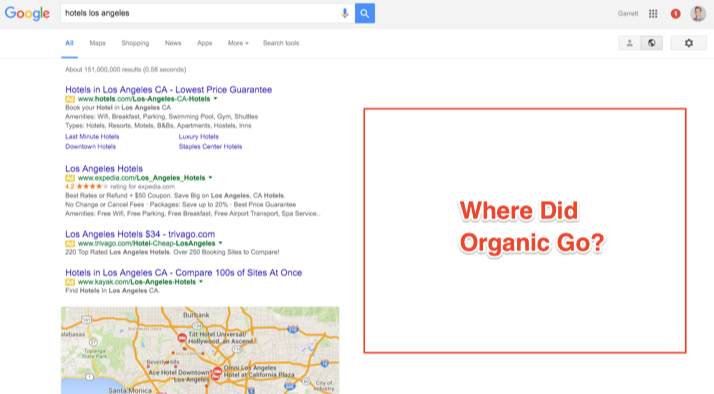
Google is an ad engine. They are not a search engine operating without a financial objective. As Google evolves, they are constantly taking more SERP real estate.


where-did-organic-search-go-google


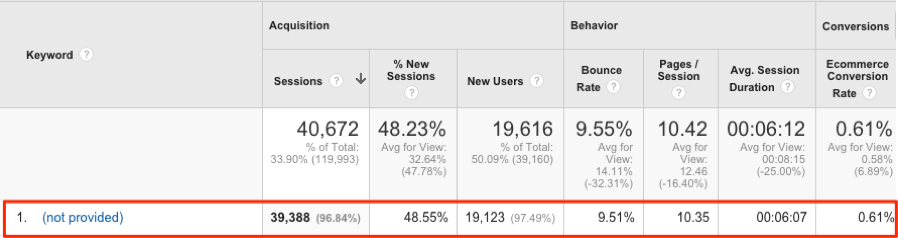
As Google daily takes more room above the fold, they also have restricted the availability of free keyword data. While there are plenty of tools that allow for keyword tracking (Moz, SEMrush, Advanced Web Ranking, etc.), none of these tell you the most important piece of data:


Which keywords are converting…


In order to obtain this data, we have to pay. Pay Google via AdWords to be exact. By having access to Google's keyword data, we can prioritize our SEO efforts correctly.


For example, imagine you are an online retailer selling men's shorts. How would you traditionally choose your keywords? You might analyze search trends, scope out the competition that is currently ranking and analyze how well they are answering the searchers intent. You may even just look at the search volume and go for it. Unfortunately, these approaches leave you operating in the dark without the ability to quickly understand what keywords convert best historically for your own target market.


not-provided-google-analytics


By beginning with paid search and then integrating the data into our SEO efforts, we are able to align search volume, rankability, and other traditional SEO metrics with the keyword conversion data from our PPC efforts. We can then correctly prioritize our content marketing and on-page SEO.


Unfortunately, as search engine marketing has grown into a science, departments have become isolated and more specialized. General practitioners knowing both SEO and PPC are a rarity. Instead, search professionals are focusing on a specialty: technical SEO, local SEO, international SEO, AdWords display, remarketing, Google Shopping, local PPC, etc.


As things become hyper specialized and fragmented, the data is lost in communication and SEO departments optimize in the dark relying on frustratingly futile metrics like keyword rankings, page views, overall organic conversions, and time on-site.


When marketing struggles like this arise, the silver lining is that tight knit teams and agencies are able to leverage the data from both the organic and paid search channels for collaborative success.


3 Dynamic Ways to Integrate Paid and Organic Traffic


There is no universal magic wand for search success. Instead, best practices exist. Below are best industry practices on how to integrate your paid and organic traffic for multichannel success.


Using Keyword Rankings as a Signal for Dataless PPC Campaigns


Google search ads are expensive. For some industries (plumbers, lawyers, etc.) cost per clicks (CPC) can exceed $100. It is difficult for most businesses to justify this high of an advertising expense on even one visitor let alone a lead. Instead, these businesses will often focus their efforts solely on SEO.


As they do so, they begin to build models of varying certainty that particular keywords are what generate their revenue.


Thus, when launching a new PPC campaign and there is significant organic traction it is essential to audit not only competitors and CPCs, but also, the Google Search Console report.


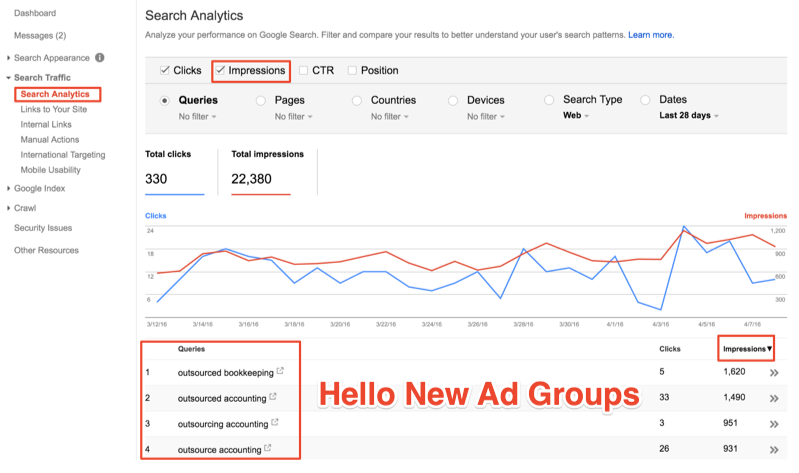
Here is a practical step-by-step process for launching a campaign for an account with organic rankings.


  1. Go to Google Search Console

  2. Click on Search Traffic > Search Analytics

  3. Add impressions data by checking the box

  4. Analyze impressions report for top queries most related to their buyer intent keywords

  5. Launch campaigns around keywords receiving the most impressions and clicks

  6. If these keywords are driving new business let's take more market share above the fold and add search ads to the marketing mix


search-analytics-webmaster-tools


Lastly, if you are using a keyword ranking tool then simply mine your top keywords driving the largest percentage of qualified traffic and take additional market share with search ads: build, launch, test, measure.


Leveraging PPC for Content Marketing to Answer User Intent


As search marketers, it is our responsibility to interject ourselves into our target market's online buying journey. Specifically, we need to strategically position our business within SERPs at all stages of the search funnel from ideation to retention.


When our target market searches for what we offer or sell online, they need to find us within the search engine results page (SERP). This can mean that we are advertising on sites that rank for our keywords meaning we show up via AdWords, in the local pack and Google Shopping, etc. The possibilities are endless, but we need to strategically execute.


One essential way search is not integrated enough is content marketing and PPC. These two services are treated far too often as distant planets operating in their own solar systems.


It's time to end that. No longer shall these services/departments operate in their own silo. Instead, there needs to be a practical intersection of the two services. But first, a basic understanding of both areas of expertise is needed.


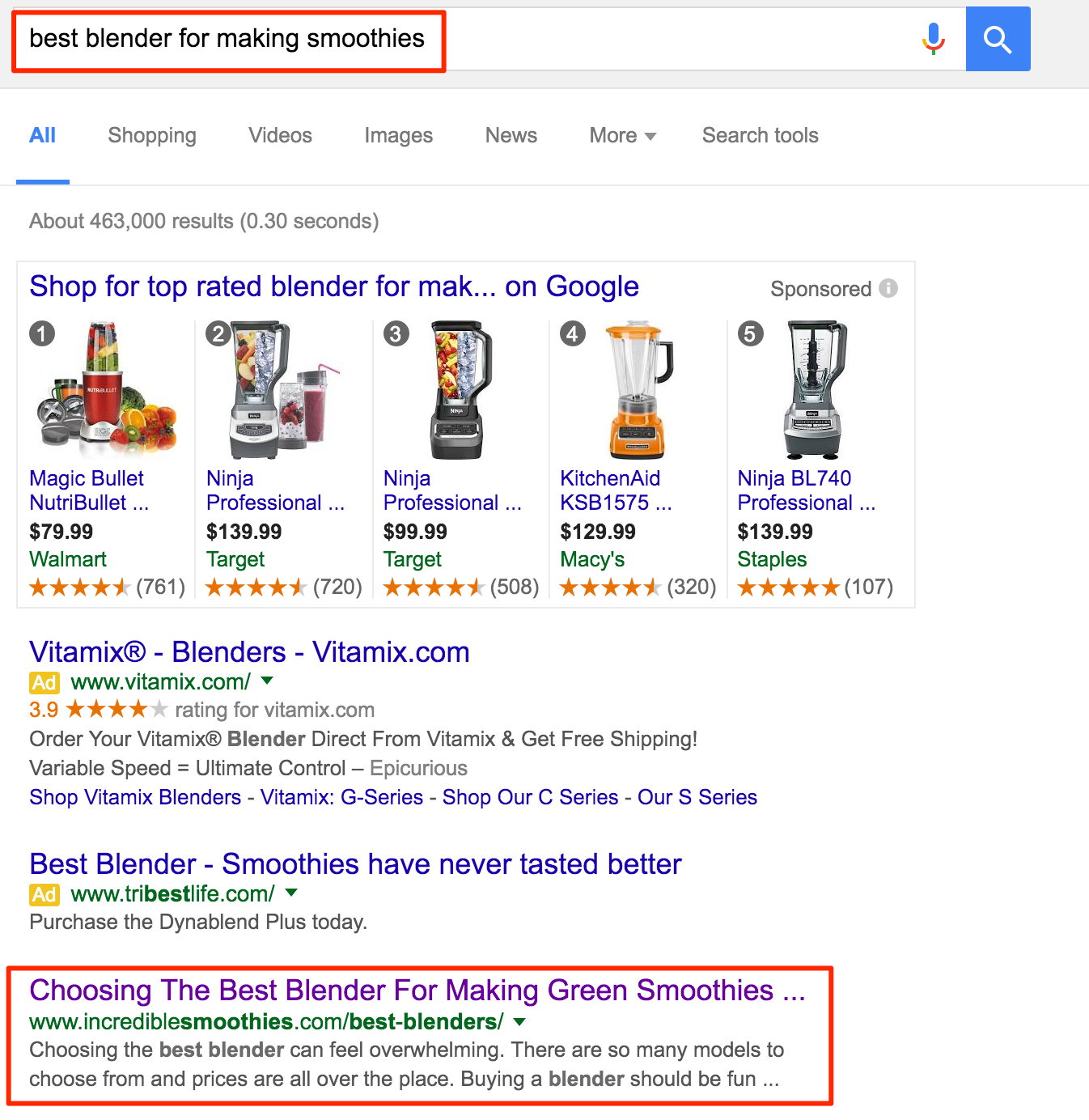
In the example below, you will find shopping ads, search ads, and a highly relevant piece of content. Imagine if the PPC team and the content team were on the same page and your brand was in all three spots!


blender-keyword-google


In the discovery stage of PPC, the specialist is looking to design an account architecture that allows them to position their keywords in different areas of a target buyer's journey through the SERPs.


To fully understand what their target market is searching for, they will often begin with broad match modified keywords. This tactic will show your ad in any search that contains your keywords. For example, “+blender +smoothie” will show your ad for any searches containing both keywords regardless of the order.


By mining the search term reports, we are now able to see the user intent of our target market based on the keywords they are searching for when they click on our ads. We can now provide this data to the content marketing department with all of our highest converting longtail keywords.


With this information, the content marketing team can analyze search volume, rankability, and brand fit to create content around this query.


The end goal is that we are now able to not only show an ad on these high converting SERPs, but also rank organically on this page above the fold.


Using Google Display Ads to Hack Key SEO Terms


Often times, we are not able to take total market share for high performing queries. Let's use my company, Directive Consulting, for this example. We want to rank for “seo company” in our area, but, because “seo company” is localized, we have a greater chance of ranking in our city, Irvine, CA.


If, however, we want to rank nationally and increase our lead volume, it is pertinent that we look at national results and see if any of those results/websites have display ads.


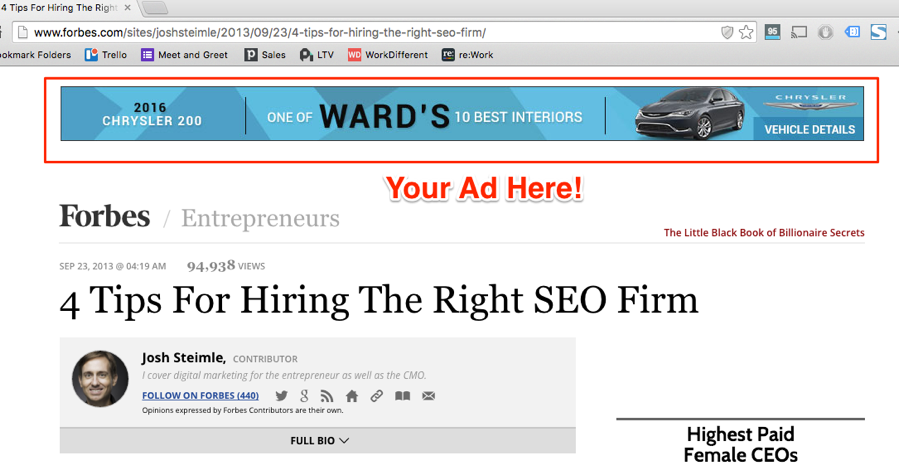
For this exact query, Forbes wrote an article entitled: “4 Tips for Hiring the Right SEO Firm”. The article ranks very well nationally, and is a frequent stop for someone looking to hire an agency. In a freaky intersection of SEO and Google's Display Network, we can take advantage of a site that ranks well for our target keyword and position our business once again within the buyer's journey by advertising with a display ad on that website.


We simply need to go into our Adwords account, create compelling display ads, and position ourselves on the page above the fold! See below.


seo-firm-advertisement


The goal should no longer be to rank solely organically for a keyword or for pay-per-click advertising. Instead, we need to integrate both channels through remarketing, display, and search.


The key is to place yourself as many times as possible in your target markets SERP journey, while measuring the performance and budget according to results and re-allocating.


Conclusion


No longer are isolated search campaigns an option. The landscape is too competitive and the buyer journey is multi-faceted. Your campaigns need to think beyond isolation and move towards integration.


As mentioned, the following tactics provide a foundational way that you can take a step towards dynamic integration:


  • Using Keyword Rankings as a Signal for Dataless PPC Campaigns

  • Leveraging PPC for Content Marketing to Answer User Intent

  • Using Google Display Ads to Hack Key SEO Terms


The tactics provided here provide a brief look into the dynamic ways you can integrate your campaigns, but the execution will be key.


As Google daily takes more SERP real estate for paid advertising, PPC will play an even larger role tomorrow than today. Furthermore, as the field becomes more competitive, the CPC's will only rise.


The businesses that best leverage content and integrate their efforts with first party data from their paid search department will lead the pack.


About the Author: Garrett Mehrguth is the CEO of Directive Consulting, a Google Partner and MozLocal Recommended Agency serving mid-enterprise level firms.He has been published in Moz, Ahref, Convince and Convert, Wordstream, Raven, Local Search Ranking Factors, and more. He has spoken at MozCon Ignite, General Assembly, PeopleSpace Innovation Labs, SoCal Code Camp and others.

Monday, April 25, 2016

How to Create a Buyer Persona Map (Even if You Have No Idea Who Your Customers Really Are)

Buyer personas. Creating potential customer profiles is often enough to make even the best marketer freeze in their tracks – and realize how little they really know about their prospects.


If this sounds like you, don't worry. And even if you've never created a buyer persona in your life, today's article will help make sense of the process by giving you a sort of “map” to follow.  Let's take a closer look.


Starting Fresh: Getting the Basics


The very first step in your map is going to be the core information about your customer. Things like:


  • Gender

  • Age range

  • Job title

  • Job responsibilities


You can likely get that much from the data stored in your CRM.


I'd also recommend “humanizing” the persona with a name and image. Doing so tends to bring out more of our emotional, empathetic side rather than looking at the potential customer as a number to slot somewhere into a sales funnel like a puzzle piece.


Learning from Example


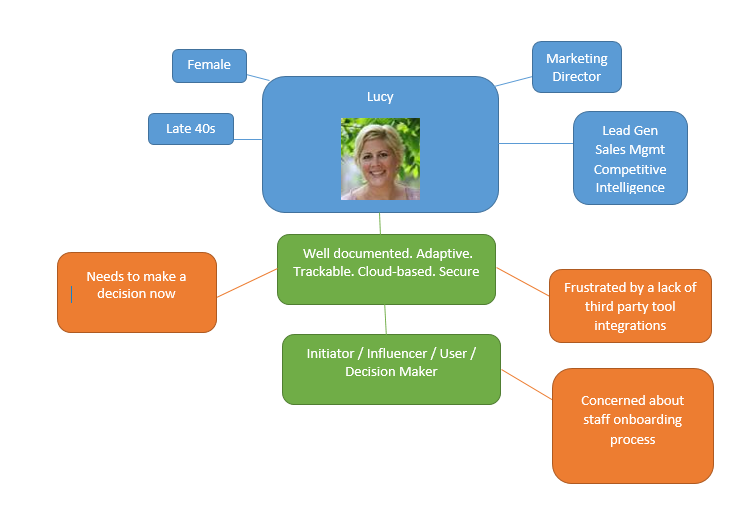
For our example here, we've chosen to work with “Lucy”, a marketing director in her late 40s. Her job primarily entails lead generation, sales management, and gathering competitive intelligence. She organizes and prioritizes campaigns. She's a pro at gathering competitive intelligence and using it wisely to help reinforce the brand and cement customer loyalty in a very competitive marketplace.


Because of the huge growth in social media, Lucy's looking for a way to streamline the interaction process on social media without losing the “personability” of the brand. She's in the market for a system/solution and wants to make a confident decision quickly.


So with this in mind, our persona map is going to look something like this so far:


buyer-persona1


Now, to liken this back to a map concept, we've got our starting point. Next, it's time to look at the journey.


Our first stop along the map is the buyer's needs. She has the basic research to know what's out there. If we were looking at this from a traditional sales funnel point of view, she's at the “comparison shopping” stage.  She'll be looking to make a decision soon.


Understanding the Buyer's Needs


Buyers are eager to tell you what they need. All you have to do is ask. Basic lead follow-up and nurturing questions can reveal quite a bit. Simple polls and surveys can often reveal a great deal about where the buyer actually is in the process (and whether they have an urgent need for your product or service versus basic curiosity). Even if we don't know specifically what they need, we can make some blanket statements to apply them to our persona. What would someone in this job typically need from our solution?


For starters, the buyer likely needs the product to be well documented. She'll be managing dozens, perhaps hundreds of staff members – some of whom (based on age) may be more technically savvy than she is. Some of the staff may pick it up quickly, others may need more time.  We'll add the needs and the persona's place in the decision-making process (one persona can have multiple roles in the decision process - they can be a user and initiator, for example)


buyer-persona2


There's also the fact that whatever solution needs to be adaptive and flexible to accommodate existing platforms and tools. The company itself likely has certain procedures and requirements of its own that need to be added to the mix, like cloud-based access and certain security protocols. These kinds of factors can influence and even conflict with what the primary buyer wants. Never mind that decisions like these are often made by committee, which lengthens the time needed and the requested features.


Dealing with Common Objections


Like all maps, there are roadblocks that are likely preventing your customer from taking action.  There are constraints and concerns, frustrations and issues that affect their decision.  You can brainstorm these obstacles and add them to the map to ensure that sales knows how to address the most common objections before they become major pain points.


You also have to decide where this buyer falls on the scale of decision-making. Will they be using the product? Influencing the decision-maker? Initiating contact with the company? A mix of all of these? Make a note of these objections and the buyer persona's place in the decision-making cycle on your map.


Following our example, we end up with something like this:


buyer-persona3


Here, we've managed to discover (and brainstorm) the buyer's potential:


  • Needs

  • Concerns

  • Frustrations

  • Urgency/Timeframe to Buy

  • Place in the buying cycle

  • Requirements


All the kinds of sales-propelling information needed to acknowledge objections, concerns and frustrations while concentrating on needs, requirements and urgency.  We've not only learned core demographics about our buyer, but key information that may be preventing them from action, or details that could move a sale into the next stage.


Our buyer persona map is less of a neatly-organized, bulleted list and more like a mind-map that's always being added to and revised.  It may not be as tidy, but our map is more authentic, and closer to the actual customer experience.


Think about the last time your company made a major purchase. It's seldom a “beginning to end” one-time shot, isn't it? There's lots of details to hammer out, lots of presentations to sit through, lots of suggestions and sign-offs to gather. It's a big process and a fancy list of bullets just doesn't cut it anymore – not in today's two-way communication world.


The Bottom Line on Understanding Buyer Behavior


It might seem counter-intuitive to go through this entire process with every type of buyer your company encounters. After all, you've likely got a lot more than just one type of customer. And if you're in retail, you've got suppliers, wholesalers, resellers, and a whole avalanche of personas out there.  Don't panic, prioritize. Focus on your best customers and find the unifying threads that tie them together, and then build on that persona.


And remember that buyers are multi-faceted human beings. Sometimes they make decisions that go against the grain of even the best, most well-developed persona. It happens. But here, it pays to remember that the journey is just as important as the destination, and the easier you make that journey, the more receptive the buyer will be to taking the action you want them to take.


About the Author: Sherice Jacob helps business owners improve website design and increase conversion rates through compelling copywriting, user-friendly design and smart analytics analysis. Learn more at iElectrify.com and download your free web copy tune-up and conversion checklist today! Follow @sherice on Twitter, LinkedIn or Google+ for more articles like this!

SearchCap: Google purple ads, Shopping ads & more

Below is what happened in search today, as reported on Search Engine Land and from other places across the web.

The post SearchCap: Google purple ads, Shopping ads & more appeared first on Search Engine Land.


Please visit Search Engine Land for the full article.


Can We Predict the Google Weather?

Posted by Dr-Pete

[Estimated read time: 7 minutes]


Four years ago, just weeks before the first Penguin update, the MozCast project started collecting its first real data. Detecting and interpreting Google algorithm updates has been both a far more difficult and far more rewarding challenge than I ever expected, and I've learned a lot along the way, but there's one nagging question that I've never been able to answer with any satisfaction. Can we use past Google data to predict future updates?

Before any analysis, I've always been a fan of using my eyes. What does Google algorithm "weather" look like over a long time-period? Here's a full year of MozCast temperatures:


Most of us know by now that Google isn't a quiet machine that hums along until the occasional named update happens a few times a year. The algorithm is changing constantly and, even if it wasn't, the web is changing constantly around it. Finding the signal in the noise is hard enough, but what does any peak or valley in this graph tell you about when the next peak might arrive? Very little, at first glance.


It's worse than that, though


Even before we dive into the data, there's a fundamental problem with trying to predict future algorithm updates. To understand it, let's look at a different problem - predicting real-world weather. Predicting the weather in the real world is incredibly difficult and takes a massive amount of data to do well, but we know that that weather follows a set of natural laws. Ultimately, no matter how complex the problem is, there is a chain of causality between today's weather and tomorrow's and a pattern in the chaos.


The Google algorithm is built by people, driven by human motivations and politics, and is only constrained by the rules of what's technologically possible. Granted, Google won't replace the entire SERP with a picture of a cheese sandwich tomorrow, but they can update the algorithm at any time, for any reason. There are no natural laws that link tomorrow's algorithm to today's. History can tell us about Google's motivations and we can make reasonable predictions about the algorithm's future, but those future algorithm updates are not necessarily bound to any pattern or schedule.


What do we actually know?


If we trust Google's public statements, we know that there are a lot of algorithm updates. The fact that only a handful get named is part of why we built MozCast in the first place. Back in 2011, Eric Schmidt testified before Congress, and his written testimony included the following data:


To give you a sense of the scale of the changes that Google considers, in 2010 we conducted 13,311 precision evaluations to see whether proposed algorithm changes improved the quality of its search results, 8,157 side-by-side experiments where it presented two sets of search results to a panel of human testers and had the evaluators rank which set of results was better, and 2,800 click evaluations to see how a small sample of real-life Google users responded to the change. Ultimately, the process resulted in 516 changes that were determined to be useful to users based on the data and, therefore, were made to Google's algorithm.

I've highlighted one phrase - "516 changes". At a time when we believed Google made maybe a dozen updates per year, Schmidt revealed that it was closer to 10X/week. Now, we don't know how Google defines "changes," and many of these changes were undoubtedly small, but it's clear that Google is constantly changing.


Google's How Search Works page reveals that, in 2012, they made 665 "improvements" or "launches" based on an incredible 118,812 precision evaluations. In August of 2014, Amit Singhal stated on Google+ that they had made "more than 890 improvements to Google Search last year alone." It's unclear whether that referred to the preceding 12 months or calendar year 2013.


We don't have a public number for the past couple of years, but it is incredibly unlikely that the rate of change has slowed. Google is making changes to search on the order of 2X/day.

Of course, anyone who has experience in software development realizes that Google didn't evenly divide 890 improvements over the year and release one every 9 hours and 51 minutes. That would be impractical for many reasons. It's very likely that releases are rolled out in chunks and are tied to some kind of internal process or schedule. That process or schedule may be irregular, but humans at Google have to approve, release, and audit every change.


In March of 2012, Google released a video of their weekly Search Quality meeting, which, at the time, they said occurred "almost every Thursday". This video and other statements since reveal a systematic process within Google by which updates are reviewed and approved. It doesn't take very advanced math to see that there are many more updates per year than there are weekly meetings.


Is there a weekly pattern?


Maybe we can't predict the exact date of the next update, but is there any regularity to the pattern at all? Admittedly, it's a bit hard to tell from the graph at the beginning of this post. Analyzing an irregular time series (where both the period between spikes and intensity of those spikes changes) takes some very hairy math, so I decided to start a little simpler.


I started by assuming that a regular pattern was present and looking for a way to remove some of the noise based on that assumption. The simplest analysis that yielded results involved taking a 3-day moving average and calculating the Mean Standard Error (MSE). In other words, for every temperature (each temperature is a single day), take the mean of that day and the day on either side of it (a 3-day window) and square the difference between that day's temperature and the 3-day mean. This exaggerates stand-alone peaks, and smooths some of the noisier sequences, resulting in the following graph:


This post was inspired in part by February 2016, which showed an unusually high signal-to-noise ratio. So, let's zoom in on just the last 90 days of the graph:


See peaks 2–6 (starting on January 21)? The space between them, respectively, is 6 days, 7 days, 7 days, and 8 days. Then, there's a 2-week gap to the next, smaller spike (March 3) and another 8 days to the one after that. While this is hardly proof of a clear regular pattern, it's hard to believe the weekly pacing is entirely a coincidence, given what we know about the algorithm update approval process.


This pattern is less clear in other months, and I'm not suggesting that a weekly update cycle is the whole picture. We know Google also does large data refreshes (including Penguin) and sometimes rolls updates out over multiple days (or even weeks). There's a similar, although noisier, pattern in April 2015 (the first part of the 12-month MSE graph). It's also interesting to note the activity levels around Christmas 2015:


Despite all of our conspiracy theories, there really did seem to be a 2015 Christmas lull in Google activity, lasting approximately 4 weeks, followed by a fairly large spike that may reflect some catch-up updates. Engineers go on vacation, too. Notice that that first January spike is followed by a roughly 2-week gap and then two 1-week gaps.


The most frequent day of the week for these spikes seems to be Wednesday, which is odd, if we believe there's some connection to Google's Thursday meetings. It's possible that these approximately weekly cycles are related to naturally occurring mid-week search patterns, although we'd generally expect less pronounced peaks if change were related to something like mid-week traffic spikes or news volume.


Did we win Google yet?


I've written at length about why I think algorithm updates still matter, but, tactically speaking, I don't believe we should try to plan our efforts around weekly updates. Many updates are very small and even some that are large on average may not effect our employer or clients.


I view the Google weather as a bit like the unemployment rate. It's interesting to know whether that rate is, say, 5% or 7%, but ultimately what matters to you is whether or not you have a job. Low or high unemployment is a useful economic indicator and may help you decide whether to risk finding a new job, but it doesn't determine your fate. Likewise, measuring the temperature of the algorithm can teach us something about the system as a whole, but the temperature on any given day doesn't decide your success or failure.


Ultimately, instead of trying to predict when an algorithm update will happen, we should focus on the motivations behind those updates and what they signal about Google's intent. We don't know exactly when the hammer will fall, but we can get out of the way in plenty of time if we're paying attention.


Sign up for The Moz Top 10, a semimonthly mailer updating you on the top ten hottest pieces of SEO news, tips, and rad links uncovered by the Moz team. Think of it as your exclusive digest of stuff you don't have time to hunt down but want to read!

Sunday, April 24, 2016

3 Productivity Lessons From HubSpot Co-Founder Dharmesh Shah

dharmesh-productivity-lessons.jpg


This post originally appeared on HubSpot's Sales Blog. To read more content like this, subscribe to Sales.


Successful founders are productive. I'm not sure if they're successful because they're productive, or if they forced themselves to become productive because they wanted to be successful. It's very much a chicken-or-egg question.


But the fact remains that even though successful founders only have 24 hours in a day, they can build quadricorns while the rest of us are doing … well, who knows what?


(I'm still mourning the loss of scheduled naptime.)


Dharmesh Shah is an example of one of those founders. Since he co-founded HubSpot almost 10 years ago, the business has grown from $0 to $181M in annual revenue. We employ over 1,100 employees and serve over 18,000 customers.


Not too shabby.


So last week, I asked him exactly how he approaches his work. Below are the three productivity tips he uses to get stuff done.


3 Productivity Lessons From Dharmesh Shah


1) Sleep 30 minutes more a day.


Sleep Expert Laura Vanderkam says that people regularly report working more hours than they actually do. We're used to glorifying professionals who work a lot. That's why people say, “I'll sleep when I'm dead,” right?


If you subscribe to this school of thought, I urge you to rethink it. The first thing Dharmesh told me was that an extra half-hour of sleep is the “highest ROI” that entrepreneurs and professionals will ever get -- period.


We all know from common sense and personal experience that when we're tired, we can't perform at our best. But science backs this tip up, too.


In a 1997 study, Drew Dawson and Kathryn Reid found that sleep deprivation has roughly the same effect on our performance as alcohol intoxication. If you're sleeping fewer than six hours a night, you'll experience the same effects as if you had a blood alcohol concentration of 0.08 -- the legal limit for driving.


You'll never be at your best if you're tired and distracted, so avoid overworking. It'll pay off in the long run.


2) Work on one task at a time.


“Don't kid yourself that you can multitask -- you can't,” Dharmesh said. “Task switching is cognitively expensive.”


The human brain is only wired to focus on one thing at a time. So trying to complete multiple tasks simultaneously is not only ineffective, it's actually bad for you. Stanford researchers actually found that when adult participants in their study attempted to multitask, their IQ scores lowered to the average range you'd find in an eight-year-old child. 


Instead, focus on one thing at a time -- especially when it's something you have to get right.


“Give yourself contiguous time to work on the important things,” Dharmesh suggests.


It can be tempting to jump back and forth between projects -- as you see new emails and notifications come in, your instinct is to respond immediately. But the more you're switching between tasks, the longer it will take you to complete everything. Shut off channels you're not using at the moment to minimize distraction.


3) Organize your calendar in blocks.


This one's actually two tips in one: Organize your day in chunks of tasks, and plan your days ahead of time.


“I block out time on my calendar to do the things I need to do,” Dharmesh said. “Otherwise, my day gets fragmented. Fragmented days lead to fragmented weeks -- not good.”


Depending on your job, planning can only take you so far. Surprises and shifts might just be part of your job. But if you can enter each day with a sense of your priorities, it'll be easier for you to shift things around when last-minute changes do come up.


Since you're guaranteed to face interruptions in your day, make sure the time you can plan for is structured strategically. It takes an average of 25 minutes to return to full productivity after a distraction, so minimize your mental load by knocking out similar types of tasks one after the other.


What are your best productivity tips? Let us know in the comments below.


HubSpot CRM