The post SearchCap: Google My Business API, challenges faced by agencies & more appeared first on Search Engine Land.
Please visit Search Engine Land for the full article.


SEO can sometimes feel like it stands for "Something Extremely Obscure."
As marketers, we're responsible for staying on top of what can feel like endless Google algorithm updates. And if we fail to do so, we run the risk of not showing up in search for important target keywords.
But keeping pace with all of those changes isn't easy. Thankfully, when it comes to achieving SEO success on your website, there's one rule of thumb that remains a tried-and-tested technique: optimizing your website with relevant and targeted keywords. 
By having a well-optimized site, you'll start to see results like improved visitor quality, higher conversion rates, and in the end: more closed customers.
In this article, I'm going to cover how to add keywords to your website once you've already completed your keyword research. So before you dive into this post, be sure to read this awesome blog post on how to do keyword research.
Got your keywords ready? Alright. Read on to learn what on-page SEO is, where to add those keywords to your website, and how to avoid search penalties.
SEO, or search engine optimization, is all about creating content, optimizing it, and promoting it. When we talk about SEO, we often talk about "on-page SEO" and "off-page SEO."
What's the difference? In short:
On-page SEO, or "saying something to a search engine," means optimizing individual webpages so that they rank higher on search engine results pages. The term covers both the content itself, as well as the HTML source code -- both of which can be optimized for search.
Off-page SEO, on the other hand, refers to external ranking signals like links.
Improving your on-page SEO can help your inbound marketing efforts immensely by helping you attract the right visitors to your website. You want to optimize your pages for search engines so they can understand who you are, what you do, and what you're writing about. Again, when you improve your on-page SEO, you'll help increase the organic rank of your website on search engine results pages (SERPs).
(HubSpot customers: Click here to learn how to use HubSpot's on-page SEO tool, which is built right into the software.)
Every time you add new site content, you'll want to create that content with the specific keywords you're targeting (1–2 per individual webpage) in mind. But if you already have a bunch of webpages published, then your first step will be performing an SEO audit on your current website.
An SEO audit will give you an idea of how SEO-friendly your website is overall. That way, you can update and optimize your current content for search starting with your highest-traffic webpages. The audit will also help surface any other issues you may have, like duplicate content, so you can address them immediately and start ranking better in search.
Watch this quick video series to learn how to perform an SEO site audit in detail. It'll cover how to check whether your site is being blocked by search engines, make sure your XML sitemap is working, monitor and improve site performance, spot and remove internal duplicate content, and check your site's popularity and trustworthiness.
In short, here's what you'll need to do:
Here's an example of what this might look like:
Once you've completed this process for all of your pages (or, if you have a ton of pages, at least the most important ones), then you can jump in to your site to start adding keywords.
Here are a few other helpful resources for performing SEO audits:
In order to optimize your pages for keywords, you'll need to, well ... include those keywords on your site. But not every placement of a keyword is equal: There are certain places on your website that are more optimal than others for on-page SEO.
Here's a list of some of the most important places to optimize for your chosen keywords on your site:
If you haven't optimized these sections of your site in the past, you have some work to do -- but it's up-front work that will pay off big time in the long term. To get the most bang for your buck, start with the pages that get the most traffic. Then, as you create more pages in the future, be sure to optimize as you go.
(HubSpot customers: Click here to learn how to figure out which webpages are getting the most traffic using the "Sources" report.)
Titles are the HTML element used to describe the topic of a webpage. You'll find them in the title of a search engine result page (as shown below), and in the top bar of an internet browser.
Titles have a direct impact on both searcher clickthrough rates (CTRs) and search rankings. To make your title both search-friendly and click-friendly:
Descriptions, also known as meta descriptions, are shown in search results below the title and URL, as shown below.
Descriptions can help increase CTR, but nowadays, they actually don't have a direct impact on rankings. They're there for humans, not search engine crawlers, and you should use them to tell searchers why they should click on your result. Use one of your target keywords or phrases in your meta description so they know your content is relevant to their query, but make it attractive to the viewer, too.
Bonus: You can use this cool tool from Dejan SEO to preview what your search result would look like before deciding which description to use.
It's important to use your keywords in your headings and content, as visitors are much more likely to stay on a page if they can see the terms they had searched for on it. Using keywords in your content is used by Google as a ranking factor, so doing this can help improve your SERP placement.
Just make sure you're using these keywords naturally, since Google has gotten better and better at being able to tell when people are keyword-stuffing their content. Whenever you create content, focus on what matters to your audience, not how many times you can include a keyword or keyword phrase in that content. If you do that, you'll usually find you naturally optimize for important keywords.
While it's fine to use keywords in multiple locations on your site, don't overdo it or Google will demote your webpages in search results. (And hey, no one wants to read content like that, anyway.)
You can also look at including keywords in a natural way in your image alt text and titles. Both alt text and titles are attributes that can be added to an image tag in HTML. Here's what a complete image tag might look like:
 alt="image-description" title="image tooltip"/>
An image's alt text tells search engine crawlers what an image is about, which helps it be found in search. It'll display inside the image container when an image can't be found, and it also improves accessibility for people with poor vision using screen readers.
An image title tag, on the other hand, is shown when a user hovers their mouse over the element -- kind of like a "pop-up." It won't be shown to the user when an image can't be displayed.
(HubSpot customers: Click here to learn how to add alt text and title text to your images in HubSpot.)
Adding keywords to these image attributes may seem minor, and truthfully, it isn't going to impact your search rankings as much as other things on this list. But trust us, it's worth the extra minute (if that) it takes to change the name from "IMG23940" to something accurate and descriptive.
For example, if you were to write alt text for the image below:
It's a good idea to include keywords in your URL if they accurately describe the page contents. This is particularly important for businesses that do a lot of blogging -- there's a huge opportunity to optimize your URLs on every post you publish, as every post lives on its own unique URL.
But beware: Search engines will penalize exact match domains that are keyword stuffed. So if you're thinking of starting up arizonerealestaterealtorsinarizona.com, think again. Keep it to businessname.com/topic-topic, and you should be fine.
As always, keep reader-friendliness in mind when you're creating your URLs. Overall, your URLs should make sense to humans and give them a good sense of where in your website they've landed. You should also separate words with hyphens and remove extra words (like "a" and "the") in the page part of the URL slug.
There are a couple of things you should also avoid when optimizing your site for keywords, so be careful of the following sketchy SEO practices some people (mind-bogglingly) still use.
This includes using the same color background as you do for the text, hiding them behind images, or hiding them off to the side using CSS. (I know, I can't believe I have to say it.) While this isn't as easy to catch as other black hat tactics, today's more sophisticated search engines can easily find instances of hidden keywords -- and it can result in serious search penalties.
Keyword stuffing means repeating keywords over and over again in the text, whether it's in titles, headings, descriptions, page content, URLs, or even at the bottom of a webpage in very small text. Basically, when it looks like keywords have been added unnecessarily onto a webpage, it's probably keyword stuffed.
Keyword stuffing is the oldest trick in the book when it comes to SEO -- and nowadays, search engines have been developed specifically to detect it. Not only does it look spammy, but it's not approved by search engines and will result in penalties.
This isn't quite the same as stuffing a lot of keywords into a post. This is more about not forcing a keyword in -- even if it's just one -- if it doesn't belong, contextually speaking. If you can't figure out a place to put a keyword in a piece of content, it's often a sign the content isn't that well-aligned with what your personas need, anyway.
Remember, SEO is not about incorporating as many keywords as possible. It's much more about picking content topics relevant to your target audience.
The most important thing to consider is your visitor's user experience. While optimizing your website for an algorithm sounds purely scientific, remember that the goal of search engines is the deliver the best experience possible to their end-users: searchers. If you keep that goal in mind with your SEO strategy, you'll be more likely to make good choices. Think about humans first and search engines second, and you'll be alright.
We know you're a busy marketer with a lot of things on your plate. SEO need not fall to the bottom of your priority list because of lack of knowledge -- or, worse, fear you're doing it wrong. We hope this was a helpful starting-off point for your on-page SEO efforts. Happy optimizing!
Editor's Note: This post was originally published in February 2014 and has been updated for accuracy and comprehensiveness.



In recent years, there has been a shift in attention from traffic to testing.
It makes sense, it's becoming increasingly hard to win at online marketing. In many ways, it seems like the easiest way to get more out of your traffic is by improving site performance.
As exciting as the idea of conversion rate optimization is, though, the question remains:
Which affects your marketing campaign success more-traffic quality or site quality?
It's an important question to consider. For most marketers, time and resources are limited, which means you need to spend the majority of your time in the areas that produce the best results.
So, if you have to choose between refining your traffic and perfecting your site, which optimization will give you the best bang for your buck?
To evaluate how testing and traffic affect your marketing success, let's run a quick hypothetical.
In this scenario, let's suppose that you are running paid search ads for your business. You've got a decent site/landing pages and-on average-you pay $4 per click.
Recently, you spent $20,000 on a new campaign that produced 5,000 clicks.
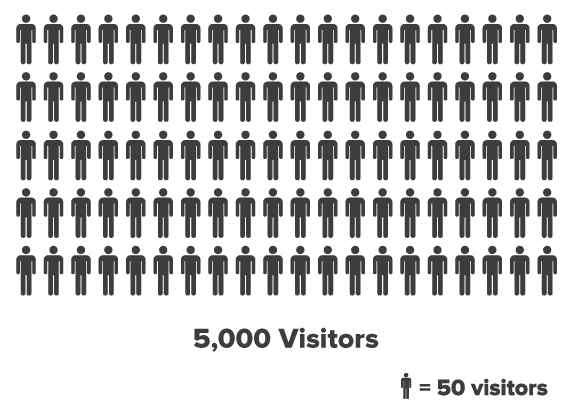
That's a lot of traffic, right?
Unfortunately, there's a problem. Most of that traffic isn't actually interested in what you're selling.
As it turns out, the average paid search account wastes 76% of it's budget on search terms that never convert. In other words, 76% of paid search ad spend goes towards the wrong traffic.
For you, that means you spent about $15,000 on clicks that have no chance of converting.
Ouch.
They may have accidentally clicked on your ad…or they thought you were selling something different than you actually sell. Maybe you were simply bidding on the wrong keywords.
Thanks to all those irrelevant clicks, only 1,250 of your 5,000 site visitors are actually potential customers.
So, in terms of your relevant traffic, here's what your ad spend really paid for:
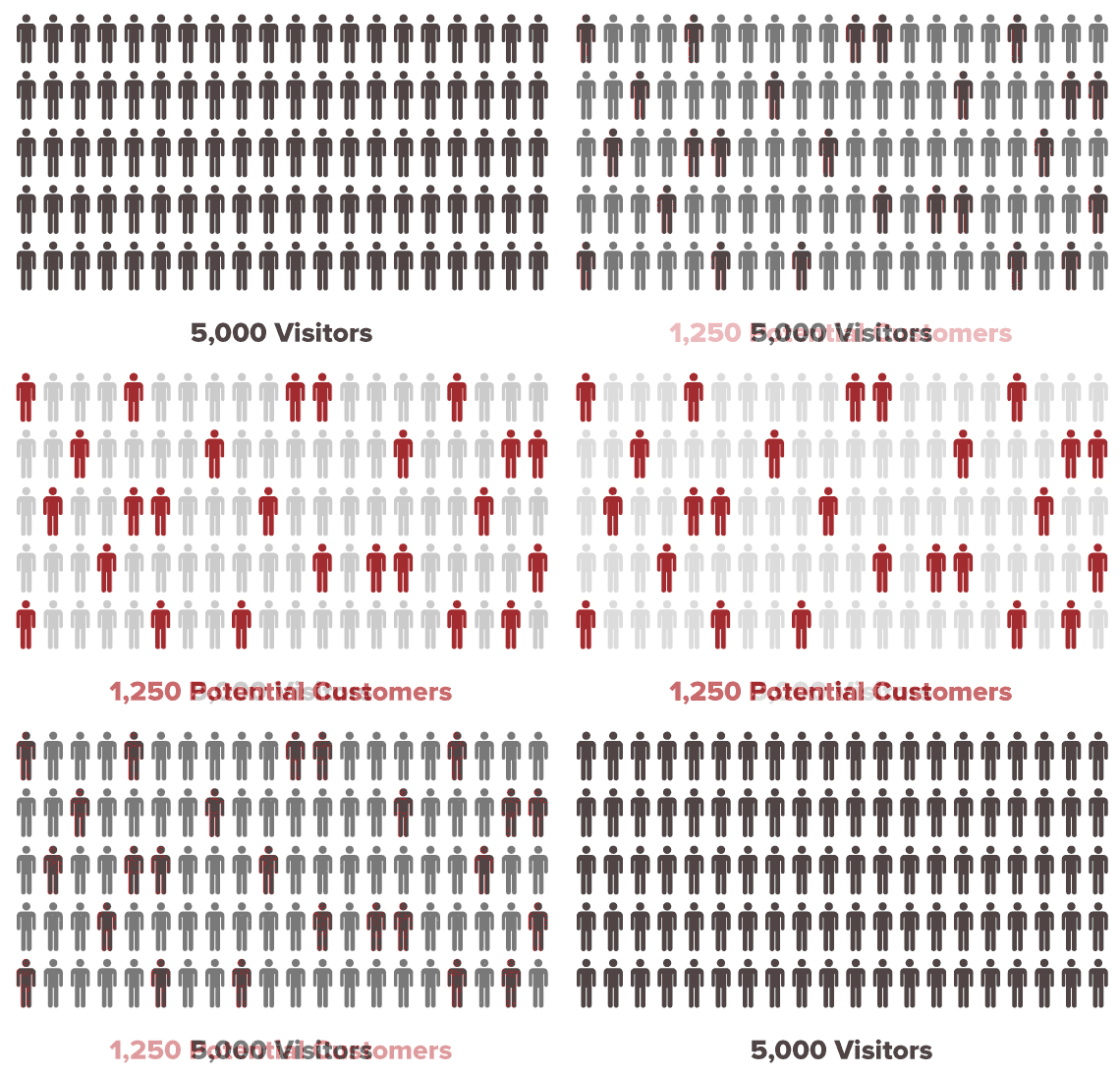
Hm, that's not nearly as exciting. You might be paying $4 per click, but you're actually paying $16 per relevant click.
But still, that's nothing a little testing can't take care of, right?
Now, as a best practice sort of marketer, you ran an A/B test on all of that traffic.
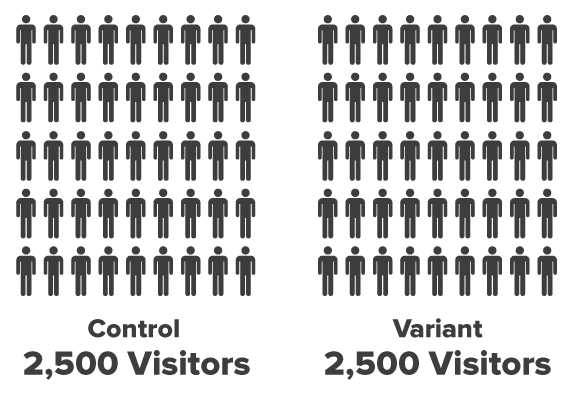
Unfortunately, what you didn't realize was that you weren't testing 5,000 visitors. Remember, only 25% of your traffic is actually interested enough to potentially convert.
As a result, you thought you were testing this:
When in reality, you were testing this:
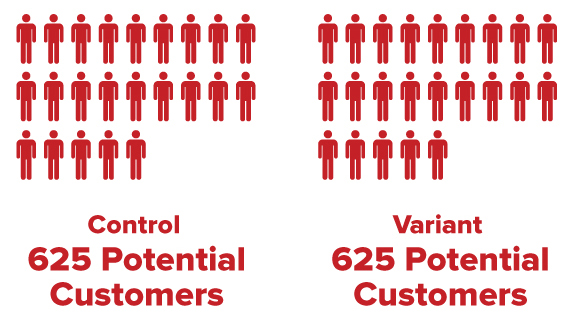
That's unfortunate, but you've still got enough traffic to run an effective test.
During your test, you get 100 conversions in your control (variant A in your A/B test) and 120 conversions from your variant (variant B).
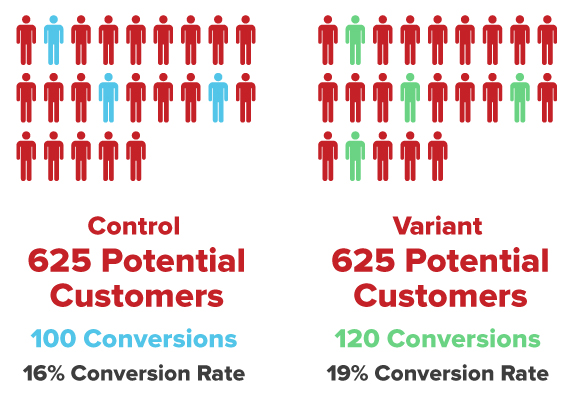
Sweet! Clearly, your interested traffic responded much better (20% better, to be precise) to your variant.
At $5 per click, you just dropped your cost-per-conversion from $25 to $20.83. The results are statistically significant, so that's a win, right?
But wait, before you start throwing confetti, remember, you didn't pay for 1,250 relevant clicks.
You paid for 5,000 clicks.
Here's what your test population actually looks like:
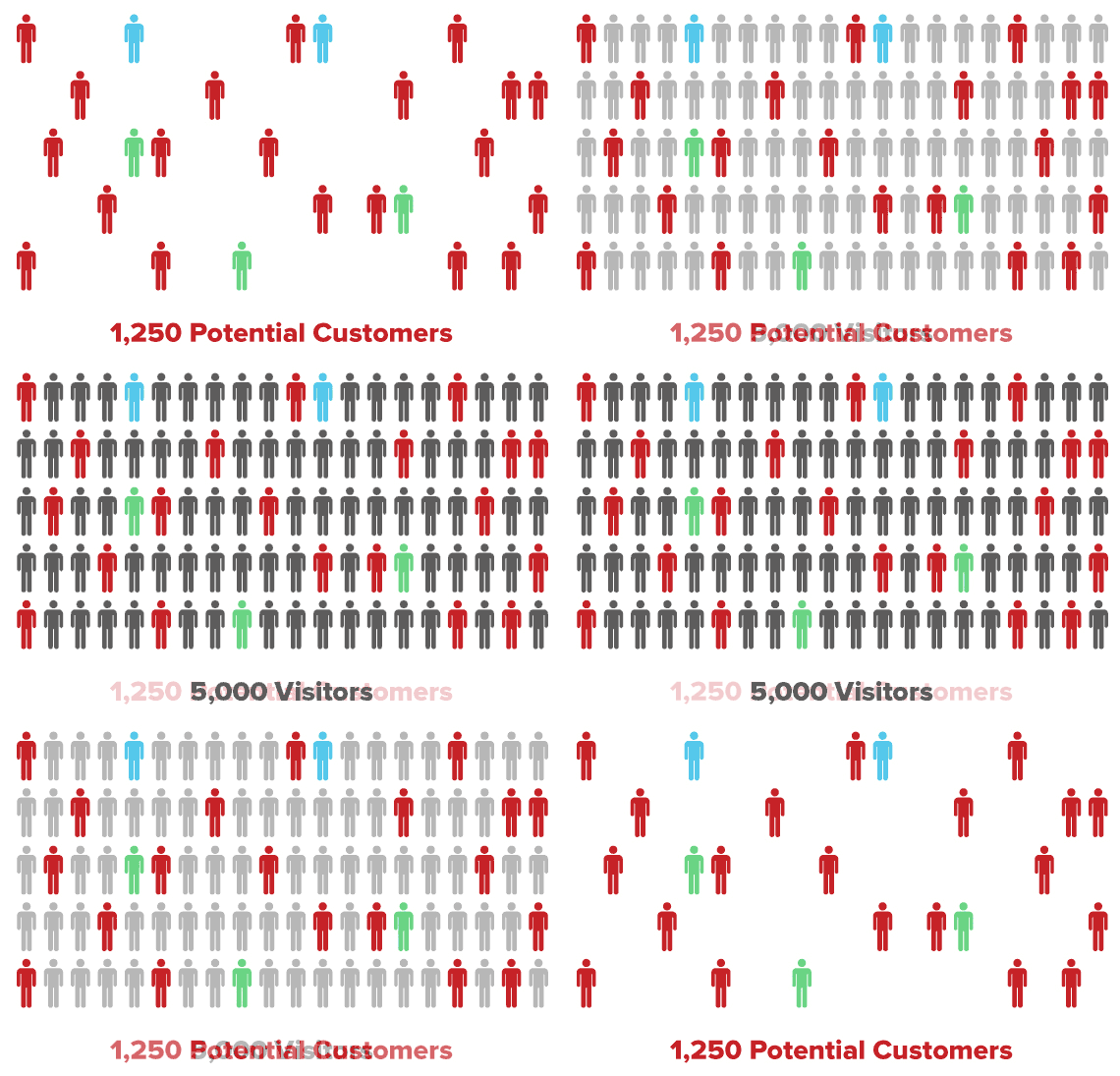
All of a sudden, your results don't seem nearly as exciting:
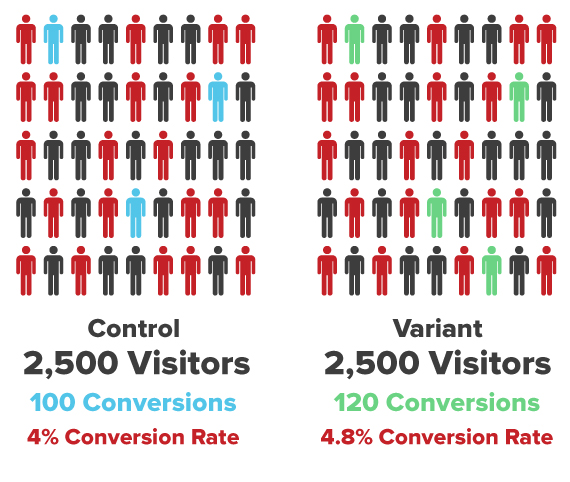
Your test is still a success. Your conversion rate went up by 20%. However, all the “wrong” traffic you paid for has diluted your conversion rates to 4% and 4.8%.
And here's the real problem-your shiny, new, optimized cost-per-conversion is $83.33.
$83.33?
But wait a minute, when we were only looking at relevant traffic, the cost-per-conversion for your control was only $25!
That means your “optimized” cost-per-conversion is over 3x what you would have paid if you were only paying for the right traffic-even without testing.
Sure, your test helped reduce your cost-per-conversion, but you can't fix your traffic by testing your website.
So, if you can't test your way out of the wrong traffic, what if you stopped paying for those irrelevant clicks?
Well, over the years, we've used this tactic countless times for clients.
Here's what happens:
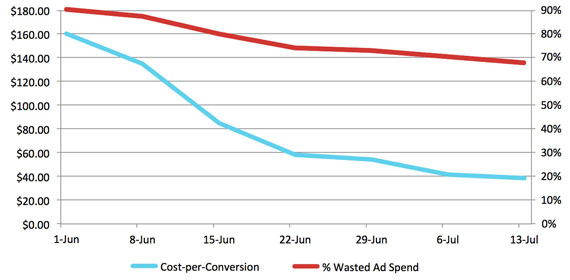
As you can see, as you waste less money on the wrong traffic, your cost-per-conversion drops…exponentially.
For this particular client, reducing their wasted ad spend from 91% to 68% cut their cost-per-conversion from $160 to $39.
And it happened in a matter of weeks.
Now, don't get me wrong. I'm a big believer in the power of testing. However, every successful test starts with the right traffic.
So, traffic or testing…where should you be focusing your efforts?
To be honest, it really depends on where your campaigns are at. If your online marketing is putting the right traffic on your site, a great testing strategy can help you squeeze every last conversion out of your clicks.
However, if you're like most business, you're probably wasting most of your budget on the wrong traffic. In this case, dialing in your marketing campaigns will deliver the biggest and fastest results.
Here are 3 things to start with:
Once your marketing is primarily driving the right traffic to your site, you can then use testing to really optimize your campaign performance.
And, since you'll be testing the right traffic, your results will be truly meaningful to your business.
Obviously, in a perfect world, you would have the time and resources to work on both traffic and testing. In the real world, though, sometimes you have to prioritize.
Having used both testing and traffic optimization for years to improve marketing performance, I'm definitely a big fan of both. However, testing works best when you are optimizing for the right traffic.
So, if you can only pick one, it makes the most sense to tighten up your traffic…and then start testing.
Traffic or testing-which would you pick? Where do you spend your time and why?
About the Author: Jacob Baadsgaard is the CEO and fearless leader of Disruptive Advertising, an online marketing agency dedicated to using PPC advertising and website optimization to drive sales. His face is as big as his heart and he loves to help businesses achieve their online potential. Connect with him on LinkedIn or Twitter.


Do you feel as though you've maxed out your local lead potential and hit a wall in your sales? Unless you have been living in a cave, you are aware that technology, and digital marketing in particular, are the keys to business growth in the 21st century.
The problem for many business owners is the rate at which technology and marketing trends change, and the befuddling number of digital marketing options (how many social networks are there?!). Just sorting through it all can feel like a second job.
To help you out, we have put together a list of a few proven ways to expand your business outside of your local sector, and attract new customers.
Put Yourself Out There
The next time you attend an outdoor event in the heat of summer, say a 4th of July Parade, you will probably notice that the kids selling water are doing big business. This is because they are putting themselves in front of people who need their service.
Nowadays, the people who need your product or service are looking online. A 2015 study revealed that 57% of consumers take recommendations found on social media into consideration before purchasing a product or service.
Start out by using just one or two social media sites, say Facebook and Twitter, and post about new products, sales, job openings and your participation in community or charity events. Be sure to pay attention to what your customers are saying on social media about the offerings in your industry- this can point you towards innovations that will put you ahead of the curve.
Writing a blog is another great way to keep the conversation going. You may think that you don't have time to write a blog for your business, but by utilizing content generation tools and services, you can publish content that will generate leads and establish you as an authority in your field.
It is now more important than ever to make sure that you are staying up with the technological advancements in your field. By combining your natural creativity and entrepreneurship with these changes in the active field, you can discover new ways to develop your products and market the outcome.
This results in much more attention from your customers in addition to an improved return on your investment. When your clients see that you are ahead of the curve and frequently innovating, they will want to learn more about your business and how they can become a part of it.
Due to increasingly streamlined technology, business owners can look forward to optimizing their operations and reducing the need for micromanagement. This frees up your time and allows you to focus on other aspects of your business.
Solutions like demographic trackers and SEO tools like Moz can allow business owners to stay ahead of the competition, especially if they are based in a particularly competitive field. Through these technological solutions, you can take a look at the statistics that matter the most.
You can see how successful your products and services are with a target audience, and you can run product tests more efficiently to determine how successful your products are.
Consider employing a content team to help you keep up on new mediums (apps, social media etc.) that may be beneficial for your business. With a content team, you can expect to keep up with your customers on a much more personal basis, especially when you are advertising for new services or specific discounts and deal plans.
Utilizing the most intuitive small business software available for your industry can make it easier for you to keep up with these mediums as well. Many software programs include mailing list options and all-in-one updaters that can allow you to upload content simultaneously across multiple platforms.
While every business owner starts out focusing on their local prospects, it is crucial to begin expansion at the appropriate stages to improve brand awareness. A creative look at the latest technological solutions can be invaluable in helping new business owners expand and fine-tune their business plan.
The post 3 Ways To Expand Your Brand appeared first on SEO Chat.


